
InvoiceFlow: The Simplest Way to Create and Send Professional Invoices Today
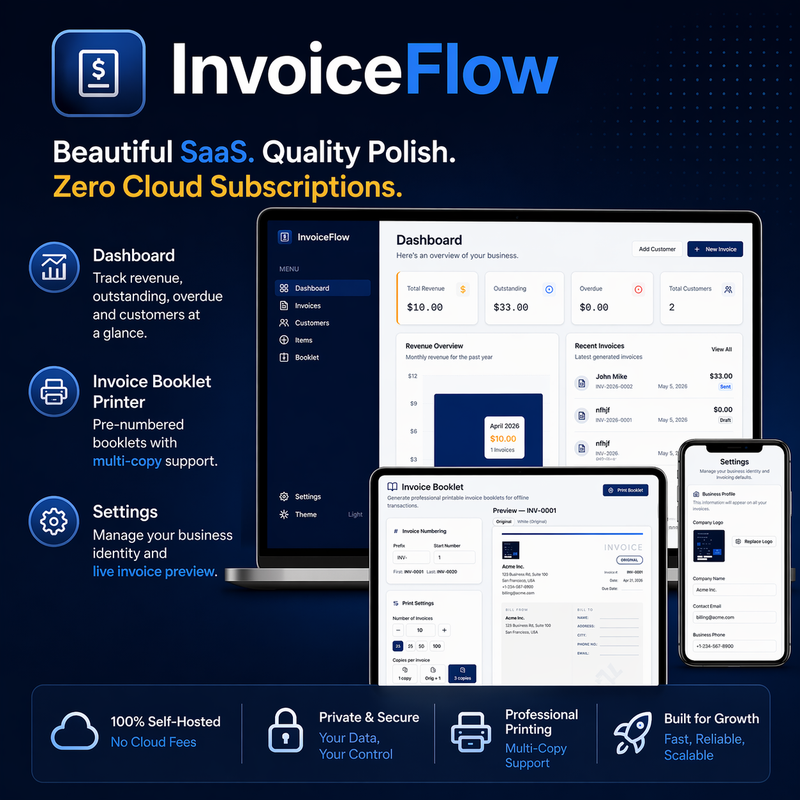
InvoiceFlow: The Simplest Way to Create and Send Professional Invoices Today
You finally landed that client. You did the work. Now it is time to get paid. But then comes the part nobody warns you about when you are starting a business: actually sending a professional invoice without spending the next two hours trying to figure out some confusing app that charges you monthly just to email a PDF.
That frustration is real, and a lot of freelancers, small business owners, and side hustlers deal with it more than they should.
This review is for InvoiceFlow, a desktop invoicing app that wants to change that experience completely. No cloud. No subscription. No monthly fees eating into your profit. Just a clean, professional invoicing tool you own outright.
➡ Get InvoiceFlow Now and Start Invoicing Like a Pro
Let us get into everything this tool offers, who it is built for, and whether it is worth your money.
What Is InvoiceFlow?
InvoiceFlow is a desktop invoicing application built for freelancers, small businesses, and anyone who needs to create and manage professional invoices without relying on cloud-based subscription software.
The pitch is simple: SaaS-quality design, zero cloud fees.
That means you buy it once, install it on your computer, and it just works. Your data stays on your machine. Nobody is reading your client list or selling your business information to advertisers. You are in full control.
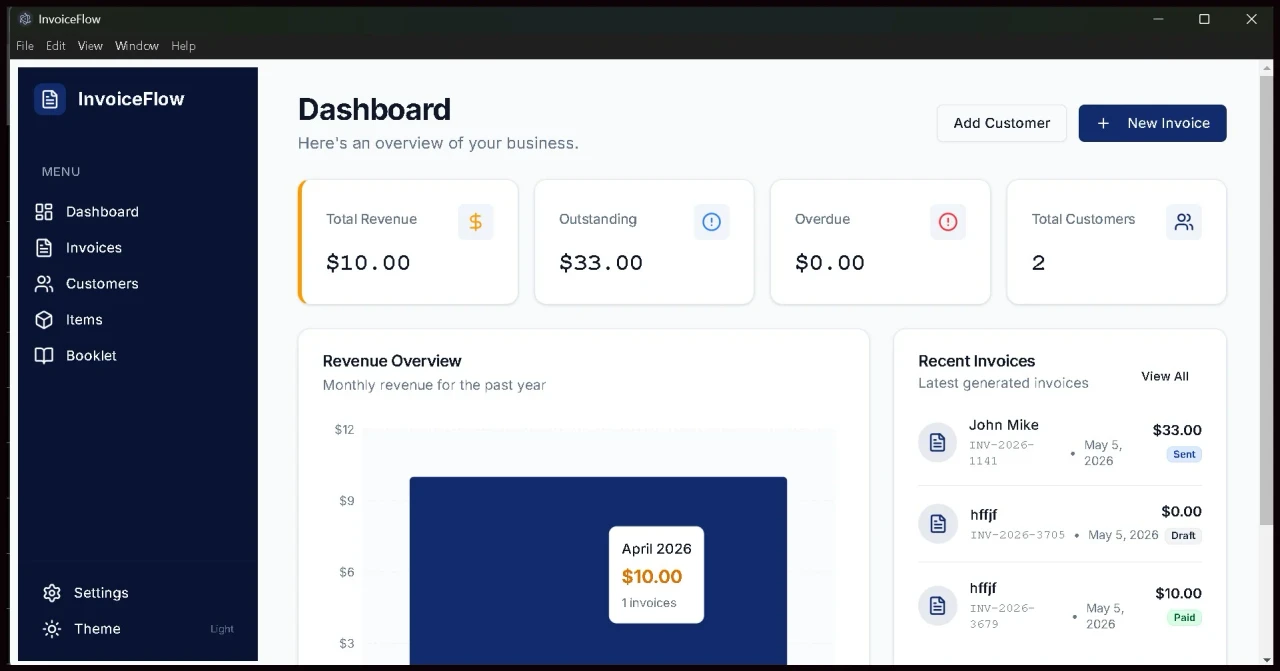
The app sits on your desktop and gives you five main sections:
- Dashboard – Your business overview at a glance
- Invoices – Create and manage all your invoices
- Customers – Keep a clean database of your clients
- Items – Save your services or products for quick invoice building
- Booklet – Generate printable invoice booklets for offline transactions
If you have ever used QuickBooks or FreshBooks and thought “this is way more than I need,” InvoiceFlow was basically built as the answer to that feeling.
➡ Try InvoiceFlow Today – One Payment, Lifetime Access
Who Actually Needs This?
Before we go into features, it helps to think about whether this is the right tool for your situation.
Freelancers and Solo Operators
If you do freelance design, writing, photography, web development, consulting, or any kind of service-based work, you need to invoice clients. A lot of freelancers start with Google Docs or Word templates, and that works fine at first. But it gets messy fast. You lose track of who paid, what is outstanding, what is overdue.
InvoiceFlow gives you structure without making things complicated.
Small Business Owners
If you run a small shop, a cleaning business, a landscaping company, a tutoring service, or anything where you are dealing with clients and money regularly, this tool was designed with you in mind. You do not need enterprise software. You need something that works, looks good, and gets out of your way.
People Who Hate Monthly Subscription Fees
This is a huge selling point. Subscription fatigue is real. You sign up for one tool, then another, then another, and suddenly you are paying $50 to $100 per month on tools you barely use. InvoiceFlow breaks that cycle with a one-time purchase model.
Business Owners Dealing With Offline Transactions
The Invoice Booklet feature is something you genuinely will not find in most cloud-based tools. If you do any business offline at markets, events, or in areas with poor internet connectivity, this is a practical solution you will actually use.
➡ Access InvoiceFlow and Stop Paying Monthly Subscription Fees
A First Look at the Dashboard
The first thing you see when you open InvoiceFlow is the dashboard, and it immediately tells you what you need to know about your business.
Four key numbers sit right at the top:
- Total Revenue – How much you have actually collected
- Outstanding – Money that is owed but not yet due
- Overdue – Payments past their due date
- Total Customers – Your active client count
Below that sits a revenue overview chart showing your monthly income for the past year. This kind of financial visibility is something you would normally pay premium pricing to get in other tools. Here it is right on your home screen.
On the right side of the dashboard, you see your recent invoices at a glance. Invoice number, client name, date, amount, and status (Draft, Sent, Paid) are all visible without clicking anywhere.
That last part matters more than it sounds. When you are running a business, speed of information is everything. Glancing at a dashboard and knowing your financial picture in five seconds beats clicking through menus and loading screens every single time.
➡ Get Your InvoiceFlow Dashboard Running Today
How the Invoicing System Works
Creating an invoice in InvoiceFlow is fast. You start a new invoice, select or add a customer, add your line items (services or products), set a due date, and you are done. The app generates a clean, professional PDF with your branding attached.
Setting Up Your Business Profile
Before you send your first invoice, you go into Settings and fill in your business details. This is where InvoiceFlow shows off one of its best features: the live invoice preview.
As you type your company name, upload your logo, and fill in your contact details, the invoice preview on the right side of the screen updates in real time. You can see exactly what your client will see before you send anything.
This live preview feature takes away the guesswork entirely. You are not sending a test invoice to your own email and hoping it looks right. You can see it right there on screen, updating as you type.
The Settings screen also lets you:
- Upload your company logo (square or horizontal works best)
- Set your default contact email
- Add your business phone number
- Toggle between light and dark mode
➡ Set Up Your Professional Business Profile on InvoiceFlow
The Invoice PDF Quality
The PDF output from InvoiceFlow is genuinely professional. It has a clean header with your logo, clear billing sections, a due date area, and a well-organized line item table. The kind of invoice that makes a client think “okay, this person runs a real operation.”
That perception matters more than most new business owners realize. An invoice built in a Google Doc can get the job done, but it quietly signals to a client that you are not fully established. A polished PDF invoice signals the opposite, and that difference can affect whether a client pays promptly or drags their feet.
The Invoice Booklet: A Feature That Stands Out
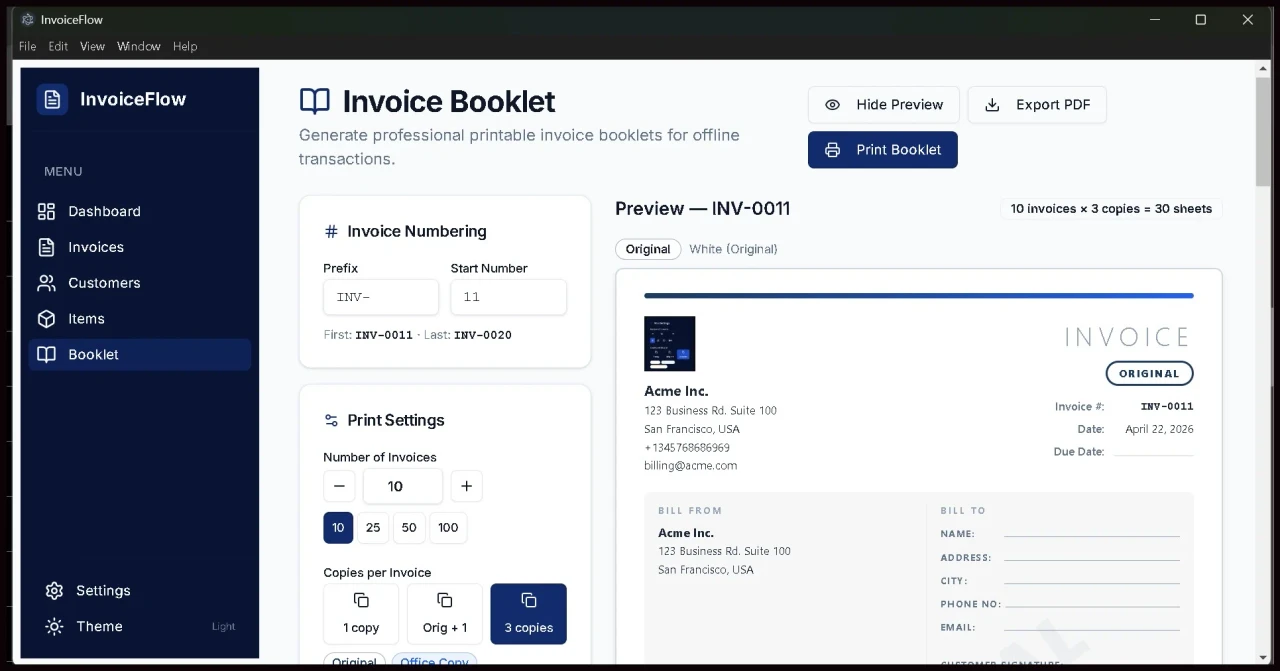
This is the feature that made me stop and pay attention when I was researching InvoiceFlow. Most invoicing tools are entirely digital. They assume you always have internet, you are always working from a laptop, and all your clients receive everything via email.
That is not reality for a lot of businesses.
The Invoice Booklet feature lets you generate pre-numbered, printable invoice booklets for offline transactions. Think of it like a physical receipt book, but generated from a professional template with your branding already on it.
How the Booklet Works
You go into the Booklet section and set your preferences:
- Invoice Prefix (like INV- or your own custom code)
- Start Number (so it continues sequentially from your last invoice)
- Number of Invoices to print (10, 25, 50, or 100)
- Copies Per Invoice (1 copy, Original plus 1, or 3 copies)
Then you preview the booklet, choose between Original or White (Original) styling, and hit Print.
The three-copy option is particularly smart. You keep one copy, your client keeps one, and you have a third for filing or your accountant. That is the same logic as the traditional carbon-copy receipt books that businesses have used for decades, but done with a professional digital template.
If you do business at markets, pop-up shops, trade events, or anywhere with spotty internet, this feature alone could justify the purchase.
➡ Download InvoiceFlow and Print Your First Invoice Booklet
Customer and Item Management
Beyond invoicing, InvoiceFlow gives you two supporting databases that make your workflow faster over time.
Customer Database
You add your clients once, with their name, address, contact details, and email. From that point on, every time you create a new invoice for them, you just select their name and all the information auto-fills. No re-typing addresses. No copy-pasting email addresses from your contacts app.
For anyone who invoices the same clients repeatedly, which is most freelancers and service businesses, this saves real time every single week.
Items Database
The Items section lets you save your standard services or products with descriptions and prices. If you are a web designer who always charges $500 for a landing page, or $150 per hour for consulting, you add those once. When building an invoice, you pull from your saved items instead of typing descriptions and prices from scratch every time.
This is the kind of feature that does not feel exciting until the third or fourth time it saves you from retyping the same things, and then you wonder how you worked without it.
➡ Start Managing Your Clients and Invoices With InvoiceFlow
The Self-Hosted Advantage: Why This Actually Matters
Let me explain something about the “100% Self-Hosted” angle, because it is more significant than it might sound at first.
When you use a cloud-based invoicing tool, your data sits on someone else’s server. Your client list, your revenue numbers, your invoice history all live on servers owned by a company you cannot fully control.
That is fine for a lot of people. But there are genuine risks worth thinking about:
- If the company shuts down, you lose access to your data
- If they raise prices, you either pay or lose your history
- If they have a data breach, your business information could be exposed
- If your internet goes down, you cannot access your own invoices
InvoiceFlow eliminates all four of those risks in one move. Your data is local. You export what you need. You are not dependent on a third party staying in business or keeping their pricing reasonable.
For small business owners who have lived through a SaaS tool shutting down (it happens more than you think), this model feels like a smart choice.
➡ Own Your Invoicing Data – Get InvoiceFlow Today
Pricing Breakdown: What You Actually Pay
This is where InvoiceFlow separates itself clearly from the competition.
Most invoicing software charges monthly:
- FreshBooks starts around $19 per month
- QuickBooks starts around $30 per month
- Wave is free but cloud-based with paid add-ons
- Invoice Ninja has a self-hosted option but requires technical setup
Over one year at $19 per month, you spend $228. Over three years, that is $684, and you still do not own the software. The company could change their pricing tomorrow and you would have no say.
InvoiceFlow is a one-time purchase. You pay once. You have it. No renewal reminders. No credit card on file. No price increases hitting you next quarter.
For freelancers just starting out, or small business owners watching their costs carefully, this pricing model removes a recurring stress from your financial life.
➡ Get InvoiceFlow at a One-Time Price Right Now
The Branding Experience: Making Your Invoices Look Like You
One thing that often gets overlooked in invoicing software reviews is the branding experience. Your invoice is a document your client reads closely, probably multiple times. It has your name, your logo, your business details, and the amount they owe you. It is one of the most viewed pieces of communication you will ever send.
InvoiceFlow takes this seriously.
When you upload your logo, it appears prominently at the top of every PDF invoice, sitting next to your business name, address, and contact details. The invoice number is clearly marked, the due date is easy to find, and the line items table is clean and readable.
There is no clutter. There are no unnecessary fields. The layout is focused on making the important information clear to whoever receives it.
This matters for a specific reason: professional invoices get paid faster. When a client receives something that looks polished and organized, it signals that you are organized too, that you track your payments, that you notice when things are late. That context alone can influence payment behavior in your favor.
Clients who receive a messy Google Doc invoice sometimes feel like they can delay payment without any real consequence. Clients who receive a clean, numbered, branded PDF from a system that clearly tracks outstanding amounts tend to take payment deadlines more seriously.
That sounds like a psychological theory, but it plays out in practice for a lot of business owners who make the switch to professional invoicing tools.
➡ Brand Your Business Properly – Get InvoiceFlow Today
Watch InvoiceFlow in Action
Before buying any software, it genuinely helps to see it working. The team behind InvoiceFlow put together a full product demo that walks through every feature in real time:
Watch the Official InvoiceFlow Product Demo on YouTube
The video walks you through the dashboard, invoice creation, the booklet generator, and the settings setup. If you are the kind of person who likes to see a product in action before committing, this is worth your time before you decide.
Real-World Use Cases: How Different People Use InvoiceFlow
Talking about features is useful, but it helps to think about how this actually plays out for real people.
The Freelance Designer
Maya does brand identity work for small businesses. She used to send invoices as Word documents, which clients sometimes could not open properly, or as PDFs built from free templates she had to rebuild from scratch every time. She set up InvoiceFlow once, saved her standard services (logo design, brand guidelines, consultation hours), and now creates a new invoice in under two minutes. Her clients get a clean, branded PDF. She can see exactly who has paid and who has not without digging through an email thread.
➡ Get InvoiceFlow and Build Invoices in Under 2 Minutes
The Market Vendor
Carlos runs a specialty food stall at two weekend markets. He cannot rely on internet at either location. He was using handwritten receipt books, but tracking what he sold and to whom was always a mess. With InvoiceFlow’s Booklet feature, he prints 25 pre-numbered invoices before each market weekend, fills them out by hand with his pre-printed business details already on each page, and tracks everything properly. When he gets home, the numbers match because the booklets are sequential.
The Cleaning Business Owner
Sophie runs a residential cleaning service with three regular clients and a rotating list of one-time jobs. She bills monthly. With InvoiceFlow, her three regular clients are saved in the system, their addresses and emails auto-fill, and her standard cleaning packages are saved as items. Monthly billing now takes about fifteen minutes total instead of the hour it used to take when she was piecing together invoices manually.
➡ See Why Service Business Owners Choose InvoiceFlow
Invoice Tracking: Knowing Who Owes You What
One of the most stressful parts of running a small business is chasing payments. You did the work. You sent the invoice. And now you are sitting here wondering if they forgot, if it went to spam, or if they are just hoping you do not notice.
InvoiceFlow does not make payment chasing automatic, but it makes staying aware of your payment situation much easier.
The status system on every invoice is simple and clear:
- Draft – Invoice is created but not yet sent
- Sent – Invoice has been sent to the client
- Paid – Payment has been received and marked
You can see the status of every invoice from the dashboard Recent Invoices panel without clicking into the individual invoice. When you are managing five, ten, or twenty clients at once, that kind of instant visibility means you catch overdue payments before they become a problem rather than after.
The Overdue count on the dashboard is particularly useful. If that number is above zero, you know exactly who to follow up with today. That single number can save you from letting a $500 or $1,000 payment sit unpaid for weeks just because it slipped your mind amid everything else you are managing.
To be fair and specific, here is where the app genuinely performs:
The live invoice preview in Settings is one of the best design decisions in the app. Seeing your branded invoice update in real time as you fill in your business details removes uncertainty and makes setup fast and satisfying.
The Invoice Booklet is genuinely unique. Most invoicing tools do not have this feature at all. For any business that operates partially offline, this fills a real gap in the market.
The dashboard gives you the right information. Total revenue, outstanding, overdue, total customers. Those four numbers tell you almost everything you need to know about your business cash flow at any given moment without having to pull a report.
The PDF quality is professional. Clean layout, proper branding space, clear due date formatting. This is not a template that looks amateur. It looks like something a properly established business sends.
One-time pricing removes ongoing cost stress. When you are trying to grow a business, every recurring subscription is a small drain. Removing that from your invoicing tool is a genuine relief.
Honest Observations About InvoiceFlow
No review worth reading pretends everything is perfect, so here are some things worth knowing before you buy.
It is a desktop app, not a mobile app. If you want to create invoices from your phone while you are out and about, this is not that tool. It is designed for desktop use, which works fine for most structured workflows but is worth knowing upfront.
It does not have built-in payment processing. You cannot set up a clickable “Pay Now” button that connects directly to Stripe or PayPal inside the invoice PDF. You can include your payment details, but automated payment collection is not part of the current feature set.
It is local-only by design, which is a tradeoff. If you work across multiple computers or want to hand invoicing off to a team member, the local-only model requires some planning around where the software lives.
These are not deal-breakers for the audience InvoiceFlow is built for. They are worth knowing so you can honestly decide if the tool fits your specific situation.
➡ Decide If InvoiceFlow Is Right for You – Check It Out Here
How InvoiceFlow Compares to Common Alternatives
InvoiceFlow vs. FreshBooks
FreshBooks is a full accounting suite. It handles invoicing, expense tracking, time tracking, and payroll integrations. If you need all of that, FreshBooks makes sense. But if you primarily need professional invoicing, you are paying a monthly fee for features you will never open. InvoiceFlow gives you the invoicing piece without the overhead.
InvoiceFlow vs. Wave
Wave is free, which is genuinely impressive. But free tools come with tradeoffs: your data is cloud-based and on their servers, the feature set has limits, and the business model depends on selling upgrades and payment processing fees. InvoiceFlow’s one-time cost gives you ownership and data privacy that Wave cannot match.
InvoiceFlow vs. Manual Templates
Building invoices manually in Word or Google Docs is free, but it does not scale well. You cannot track outstanding payments at a glance, you do not have a customer database that auto-fills, and you cannot generate print-ready booklets. InvoiceFlow saves you noticeable time every week compared to the manual approach, and the output looks more professional.
➡ Upgrade From Manual Invoicing – Get InvoiceFlow Today
Setup and Getting Started
Getting InvoiceFlow running is straightforward. You purchase it, download the installer, and run it on your desktop. The first thing the app guides you through is setting up your business profile in Settings.
A realistic setup time for most users is about 20 to 30 minutes:
- 5 minutes to fill in your business profile and upload your logo
- 10 to 15 minutes to add your regular customers
- 5 to 10 minutes to add your standard service or product items
After that initial setup, creating each new invoice takes two to three minutes. The recurring time cost is low, and it gets faster as you build out your customer and items database.
➡ Start Your InvoiceFlow Setup in the Next 30 Minutes
The Design Quality: It Actually Looks Good
This might sound like a small thing, but it is not. A lot of desktop software, especially one-time purchase tools, looks like it was designed a decade ago. Confusing layouts, cluttered menus, tiny text you have to squint at.
InvoiceFlow does not have that problem. The UI is clean, modern, and clearly designed with intention. The dark navy sidebar with clear icons, the white content area, the blue accent colors all give it a look that is on par with subscription SaaS tools that charge $30 or more per month.
Using software that looks good is genuinely more pleasant day to day. You are more likely to stay organized, check your dashboard regularly, and keep your invoicing current when the tool you are using does not feel like a chore to open.
Final Thoughts: Is InvoiceFlow Worth It?
If you are a freelancer, a small business owner, a solo operator, or anyone who needs to send professional invoices without getting locked into a monthly subscription, InvoiceFlow is worth taking seriously.
It does what it says it does. The invoicing is clean and professional. The dashboard gives you real financial visibility. The Booklet feature is genuinely useful for offline businesses. The Settings panel with live preview makes branding setup fast. And the one-time pricing model respects your budget in a way that monthly subscriptions do not.
The limitations are real but specific to niche needs. If you need mobile invoicing, built-in payment links, or multi-user cloud access, this tool is not the right fit for you. But for the person who just needs a proper, professional desktop invoicing system they own outright, InvoiceFlow delivers exactly that.
What stands out most is the focus. InvoiceFlow does not try to be everything to everyone. It tries to be excellent at the specific thing it does. That kind of focus is rare in software, and it shows in the result.
➡ Get Lifetime Access to InvoiceFlow – One Payment, Done
Quick Summary: InvoiceFlow at a Glance
What it is: A desktop invoicing app with one-time pricing
Best for: Freelancers, small business owners, offline service businesses
Standout features:
- Live invoice preview in Settings
- Invoice Booklet for offline and print use
- Clean professional PDF output
- Customer and item database
- Dashboard with revenue, outstanding, and overdue tracking
What it does not include:
- Mobile app
- Built-in payment processing
- Cloud sync across multiple devices
Pricing: One-time purchase (no monthly fees, no renewals)
➡ Grab InvoiceFlow Now and Take Control of Your Invoicing
If you have been piecing together invoices in Word documents or paying monthly for software that does way more than you need, InvoiceFlow is the kind of focused, well-built tool that makes you wonder why you waited to switch.
One purchase. Your data. Your control. Professional invoices every time.


Leave a Reply
You must be logged in to post a comment.